What Marine Life Can You See in Mahé?
One of the first things guests ask before heading out with OCEANIKA from Eden Island is simple and exciting at the same time: what marine life can you see in Mahé? The honest answer is that Mahé offers a wide variety of tropical species, but no two dives or snorkeling trips are exactly the same. As a PADI dive center operating daily around Mahé, OCEANIKA knows that this unpredictability is part of what makes the underwater world in Seychelles feel alive rather than staged.
If you are staying on Eden Island, in Victoria, Beau Vallon, or elsewhere on Mahé, you are in a strong position to explore coral reefs, granite formations, sandy patches, and occasional deeper sites that attract very different kinds of marine life. Some encounters are common enough that OCEANIKA's guides expect a good chance of seeing them. Others are more occasional and always feel special when they happen.
Reef Fish and Coral Life Around Mahé
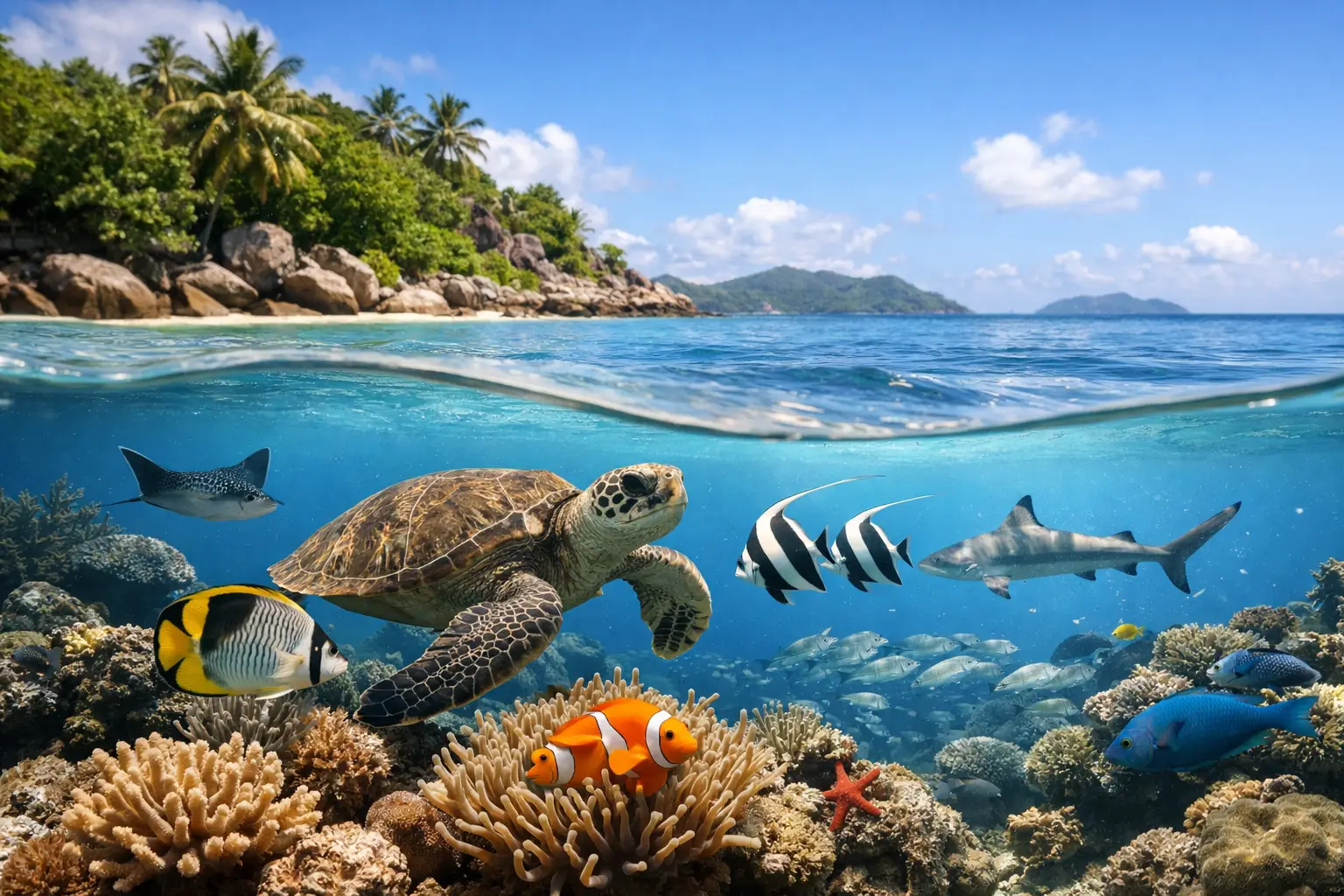
For many visitors, the first underwater impression is the sheer amount of reef fish. Even on an easy, beginner-friendly site, you may find yourself surrounded by schools of small, bright fish moving around coral heads and rocky structures. Sergeant majors, butterflyfish, angelfish, parrotfish, surgeonfish, and wrasses are all part of the usual reef scene in Seychelles.
These species are not just colorful background. They are a good sign that the reef is active and functioning. Parrotfish graze on algae, wrasses pick around crevices, and schools of smaller fish often gather where current brings food. If you are new to diving or snorkeling, this constant movement is usually what makes the first experience feel so immersive.
Mahé is also known for its mix of coral areas and granite reef structure. That matters because marine life often changes depending on the terrain. On coral-rich sections, you may notice more small reef fish and invertebrates. Around boulders, ledges, and cracks in the granite, guides often point out species that prefer shelter, including moray eels, squirrelfish, soldierfish, and scorpionfish resting against the rock.
Turtles, rays, and larger reef visitors
Many travelers come to Seychelles hoping to see larger marine animals, and Mahé can certainly deliver memorable encounters. Sea turtles are among the most sought-after sightings by both divers and snorkelers. They may be seen cruising over the reef, feeding near coral or seagrass, or resting quietly in a sheltered area.
Rays are another possibility. Depending on the conditions and the site, you may spot them passing over sandy bottoms or resting partially covered in sand. These moments tend to be calm rather than dramatic. You look down, notice a shape you almost missed, and suddenly the whole dive slows down.
Then there are the larger fish that bring a little extra excitement to the day. Trevallies, groupers, and barracuda can appear around reef edges or in slightly more open water. They are not seen on every outing, and that is worth saying clearly. Marine life in Mahé is real wild nature, not an aquarium. The reward is that when a larger animal does appear, the encounter feels genuine.
Because conditions change from day to day, OCEANIKA's instructors adapt dive site selection according to visibility, sea conditions and diver experience levels. This local knowledge helps guests enjoy the best possible marine life encounters available on the day while maintaining a safe and enjoyable experience.
Smaller creatures that divers often love most
People who have never dived before usually imagine only the big, obvious animals. Certified divers often end up talking just as much about the smaller species. Mahé has plenty to offer if you enjoy taking your time and looking closely.
Nudibranchs, flatworms, shrimp, crabs, and tiny reef fish can be hidden in coral, on sponges, or around rocky surfaces. Octopus are another favorite. They are masters of camouflage, so spotting one can feel like a small victory. Lionfish, leaf scorpionfish, and stone-colored species that blend into the reef can also be fascinating if you have a guide who knows where to look.
This is one reason guided dives matter. A site that looks simple at first glance can become much richer when you explore it with professionals who understand local marine behavior and habitat. The best sightings are not always the biggest ones.
Seasonal changes and sea conditions matter
One of the most useful things to know before booking is that marine life sightings are influenced by visibility, current, swell, water temperature, and season. That does not mean Mahé is only worth visiting at one specific time. It means the experience changes throughout the year.
On some days, clear water makes fish life easier to spot from a distance. On others, slightly different conditions may bring activity to a site that behaves differently in another season. Wind and sea state also affect whether a site is comfortable for beginners, better suited to certified divers, or more appropriate for snorkeling.
This is why local guidance matters more than generic wildlife checklists. A responsible dive center will not promise exact sightings, because no professional should. What it can do is choose the most suitable site for the day, your experience level, and the conditions on the water.
This is one of the advantages of joining a local operator such as OCEANIKA. Daily diving and snorkeling activities around Mahé provide valuable insight into current conditions, allowing sites to be selected according to the weather, visibility and guest experience levels.
Marine life for beginners, families, and certified divers
Mahé works well because it is not only for experienced divers. Beginners doing a first scuba experience often enjoy the immediate reward of seeing reef fish and learning how to breathe calmly underwater in a supervised setting. For many, that first close look at the reef is enough to turn curiosity into a real passion.
Families and teenagers often prefer snorkeling trips or easy dives where the focus is on comfort, safety, and simple enjoyment rather than depth. In those cases, the richness of shallow reef life is a real advantage. You do not need an advanced profile to have a memorable wildlife encounter in Seychelles.
Certified divers may want more variety, including sites with different topography, stronger fish activity, or a wreck environment where marine life gathers in another way. Wrecks can attract schools of fish and create shelter for species that are less visible on open reef. Again, what you may see depends on the day, but this variety is part of what makes diving around Mahé rewarding over several outings rather than just one.
How to improve your chances of seeing more
The first rule is to slow down. Fast movements, splashing, and constant direction changes make it harder to notice animals and easier to miss shy species. Good buoyancy, calm breathing, and patient observation usually lead to better sightings than chasing after movement.
The second is to listen to your guide. Local dive professionals know how specific habitats behave and where to focus your attention without disturbing the environment. They also help you enjoy the experience safely, which matters just as much as the wildlife itself.
The third is to keep expectations realistic. If your goal is to tick off one famous animal and nothing else, you may overlook the richness that is right in front of you. Mahé is at its best when you appreciate the full reef picture - the fish, the textures, the small creatures, the changing light, and the occasional larger visitor that turns a good dive into a great one.
A day on the water in Seychelles is rarely about one guaranteed sighting. It is about entering a living environment with the right team, the right mindset, and enough time to pay attention. If you come to Mahé ready for that, the marine life has a way of rewarding you when you least expect it.